
A 7-day AI exam prep plan that does not let AI take the exam for you
Build one trusted source set, test yourself early, and let every wrong answer decide what you review next.

Why AI exam prep needs a plan, not more output
AI is already part of normal student work. In HEPI's March 2026 survey of 1,054 UK undergraduates, 95% reported using AI in at least one way and 94% used generative AI to help with assessed work. Almost half said it improved their student experience, while many also worried about relying on it as a crutch.
That tension is the useful starting point. AI can remove the friction of sorting a semester of PDFs, recordings, and notes, but an exam still asks you to retrieve, compare, explain, and apply ideas without a polished answer sitting in front of you. The plan below uses AI for structure and feedback while leaving the cognitive work with you.
Before day one: create a trustworthy source set and a baseline
Choose one bounded exam scope: a module, chapter group, or official topic list. Put the relevant lecture notes, slides, PDFs, and recordings in one workspace. Remove duplicate or unrelated material, then inspect the generated outline against the originals. A fluent summary is not evidence that every detail is correct.
Now take a short diagnostic quiz before you start reviewing. Ten to fifteen mixed questions are enough. The purpose is not to score well; it is to separate what you can retrieve from what merely feels familiar. Save the misses by topic because they become the schedule for the week.
- Define the exact exam scope before uploading anything.
- Keep answers grounded in the course material, not the open web.
- Verify terminology, formulas, dates, and lecturer-specific examples.
- Start with a diagnostic quiz and tag every miss by topic.
The seven-day AI exam prep plan
Each day has one job. Work in focused blocks and stop generating new material once you have enough to practise. A smaller question set that you answer twice is more valuable than a huge deck you never finish.
- Day 1 - Map and diagnose: build the source set, generate a topic map, and take the baseline quiz.
- Day 2 - Explain the core: answer short prompts on definitions, mechanisms, and relationships without looking; repair only the gaps.
- Day 3 - Apply and compare: practise cases, calculations, contrasts, or worked examples that require more than recognition.
- Day 4 - Mix retrieval: shuffle topics and formats so the question itself no longer tells you which method to use.
- Day 5 - Simulate pressure: complete one timed, closed-note practice set and record both errors and slow answers.
- Day 6 - Repair the error log: regenerate practice only for the weak clusters and explain each answer in your own words.
- Day 7 - Consolidate: run a short confidence check, review high-yield misses, prepare materials, and stop early enough to sleep.
Make wrong answers drive the next session
Retrieval practice works because it creates observable evidence about memory. A meta-analysis covering 50 classroom experiments and 5,374 learners found that testing improved learning across education levels and content areas; 57% of the reported effects were medium or large. The useful unit is therefore not how many pages you reviewed, but which questions you can now answer unaided.
After each session, sort misses into three buckets: knowledge you never encoded, knowledge you confused with a similar idea, and knowledge you understood but could not retrieve quickly. Ask AI for a different remedy for each bucket: a concise explanation, a comparison table, or another problem with changed values. Retest later without the answer visible.
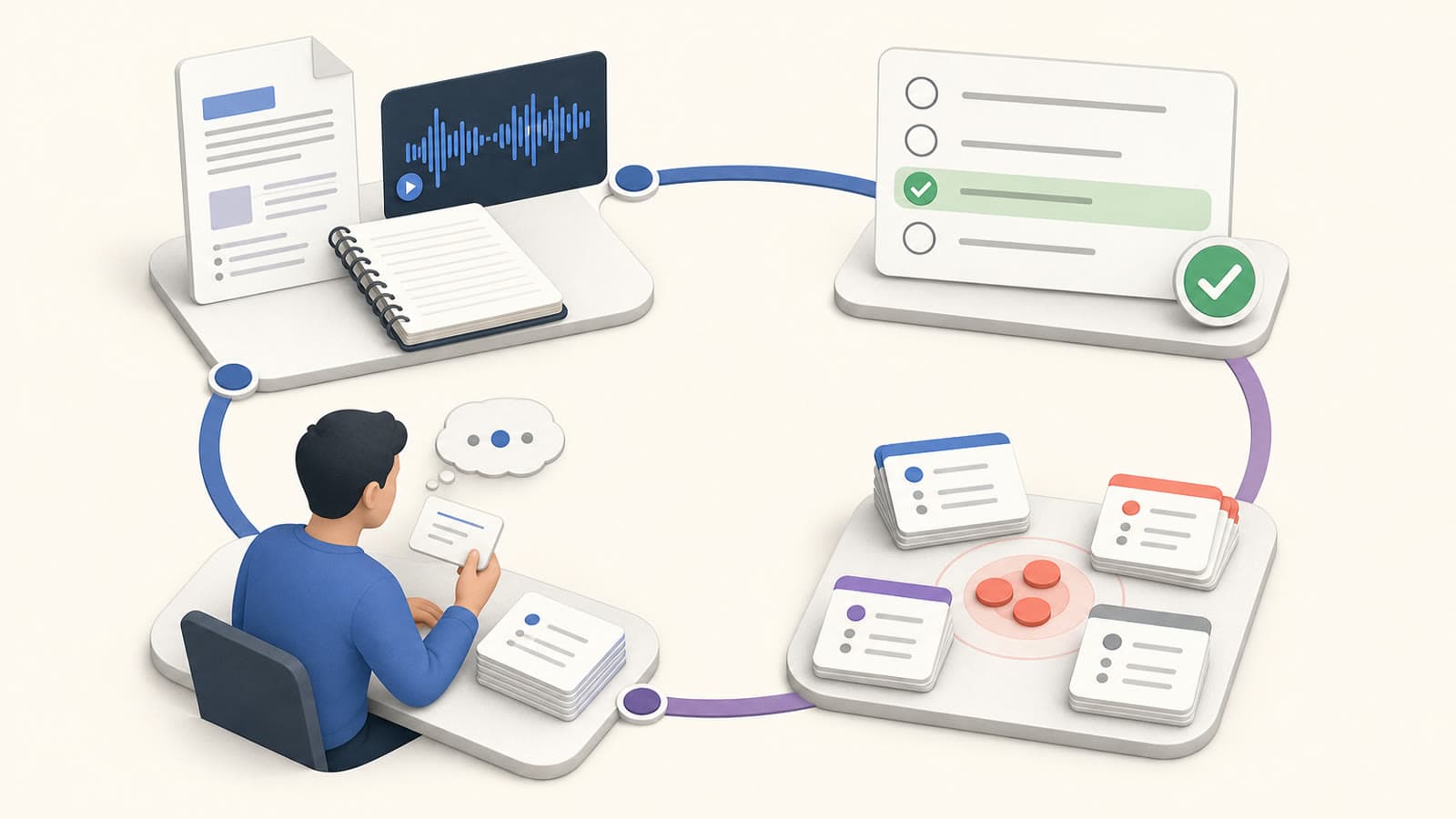
The adaptive exam review loop
Start with trusted course material, diagnose with questions, group the mistakes, and practise only the weak areas before testing again.
Prompts that turn AI into a tutor instead of an answer machine
Good study prompts delay the answer and make your thinking visible. Ask the tool to use only your sources, question you one item at a time, wait for your response, then give specific feedback and a source-grounded correction. Google has moved its own education tools in this direction with source uploads, diagnostic quizzes, adaptive lessons, and flashcards.
- Test me on this topic one question at a time. Do not reveal the answer until I commit to a response.
- Use only the uploaded material. If the source is incomplete, say what is missing instead of guessing.
- After I answer, identify the exact misconception and give me one new question that tests the same idea differently.
- Create a mixed closed-note set with recall, comparison, and application questions. Keep explanations separate until the end.
Where AI should stop
Do not upload confidential records, unpublished research, or classmates' work without permission. Follow your institution's assessment policy and cite AI assistance when required. UNESCO's guidance stresses a human-centred approach, privacy protection, and critical judgement rather than treating generative output as authority.
A useful rule is simple: AI may organize the material, ask questions, vary examples, and explain feedback. You should still choose what matters, verify claims against the source, produce the final reasoning, and decide when you genuinely understand it.
How Brainote fits this workflow
Brainote keeps the loop in one place. Bring in a PDF, lecture recording, web source, or pasted text; check the structured note; then generate flashcards and quizzes from that same context. When an explanation is unclear, chat with the note instead of starting over in a general chatbot.
Try the plan with one upcoming exam unit. Build the source set, take the baseline quiz, and let your first five misses determine tomorrow's session. The value is not more generated content. It is a shorter path from real course material to deliberate practice.
Sources and further reading
- 1.Student Generative AI Survey 2026 (Higher Education Policy Institute)
- 2.The Testing Effect in the Psychology Classroom: A Meta-Analytic Perspective (ERIC / Psychology Learning & Teaching)
- 3.New Gemini for Education tools help students learn their way (Google for Education)
- 4.Guidance for generative AI in education and research (UNESCO)
- 5.AI competency framework for students (UNESCO)
FAQ
Can AI create my entire exam study plan?
It can draft the schedule and practice material, but you should set the scope, verify the sources, and adjust the plan using your actual quiz results and exam requirements.
Is seven days enough to prepare for an exam?
Seven days is a useful focused cycle, not a promise of mastery. Start earlier for cumulative or high-stakes exams and repeat the diagnose-practise-retest loop across several weeks.
Should I use summaries, flashcards, or quizzes first?
Use a short summary to map the material, then quiz early. Convert persistent misses into flashcards or targeted prompts instead of turning every sentence into a card.
How do I know whether an AI answer is reliable?
Require source-grounded answers, check important claims against the original material, and treat uncertainty as a reason to consult the lecturer, textbook, or official documentation.
AI Exam Prep: A 7-Day Study Plan That Keeps You Thinking
A research-informed seven-day AI exam prep plan that turns course material into diagnostic quizzes, active recall, targeted review, and a realistic final-day routine.