
A study guide should help you think, not just help you store information
Use summaries as a starting point, then build a guide that points toward recall, comparison, and review.
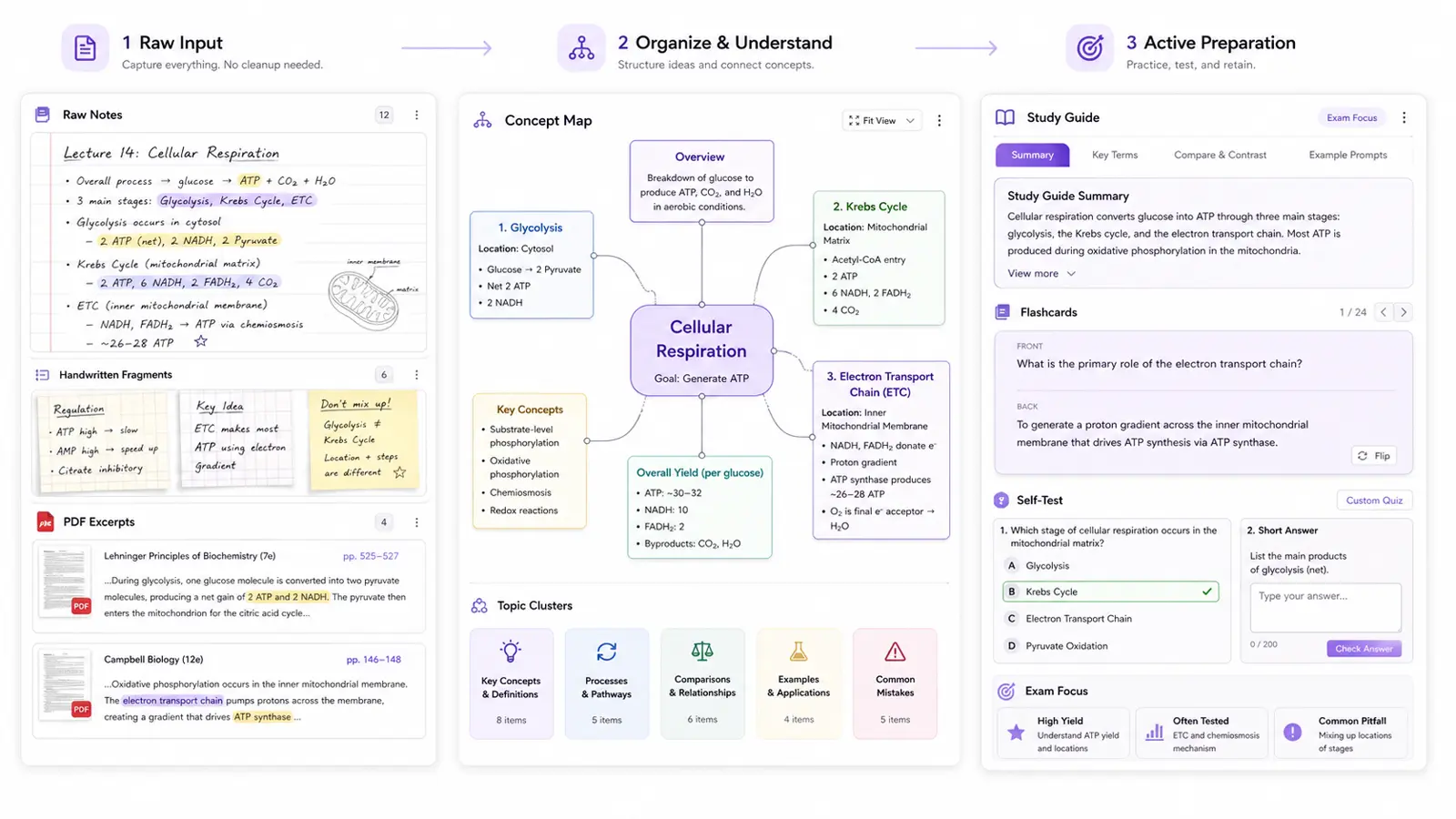
Why most student-made study guides feel useful but underperform
A common mistake is to treat a study guide as a cleaned-up version of the notes. That produces a document that is easy to skim but weak under pressure. If the guide merely compresses what you already read, it may feel efficient without revealing what you can actually retrieve from memory.
This matters because summarization by itself has limited utility compared with stronger learning techniques like practice testing and distributed review. A summary can reduce chaos, but it does not guarantee that you can explain the content, discriminate between similar concepts, or apply the idea on an exam.
The best use of a study guide generator is therefore not to create a final answer sheet. It is to organize the material into a structure that makes later testing easier.
Start with concept architecture, not pretty formatting
A strong study guide answers a few structural questions first: What are the major concepts? How do they relate to one another? Which distinctions would be easy to confuse under pressure? What examples make the theory concrete?
That means the first version of a guide should look more like a concept map than a polished summary sheet. Group terms into families. Mark contrasts. Pair each abstract idea with one example. If the course is cumulative, note what depends on what.
This is where AI can be genuinely useful. If your notes come from lectures, PDFs, and scattered annotations, a generator can pull them into one structure quickly. But the student still needs to inspect that structure and fix what matters.
A useful study guide always contains self-test material
The best study guides include built-in prompts. For every topic block, add a short question set: define this, compare these, explain why this matters, apply this to a new example. This transforms the guide from storage into a review engine.
Question generation also improves diagnosis. If you cannot turn a section into a good question, the notes are probably too vague. If all your questions are definition-only, the guide is probably too shallow. Better guides include explanation, comparison, sequencing, and application prompts.
This approach aligns much better with the research on retrieval practice. The guide becomes a launchpad for testing rather than an endpoint you reread repeatedly.
A practical guide-building workflow
Keep the process lean. Start from one source cluster, not your entire semester. Build a guide for a chapter, a lecture unit, or an upcoming quiz scope. Add only what you would realistically review in a short study block.
Then schedule a second pass where you do not edit the guide at all. Instead, use it only to quiz yourself. If a section is never useful during self-testing, simplify or remove it next time.
- Group raw notes into main ideas, subtopics, and likely confusion points.
- Turn each subtopic into a short explanation plus one concrete example.
- Add a small self-test section under each concept group.
- Use the guide in a later review block before deciding whether it is complete.
FAQ
Is a study guide better than flashcards?
They do different jobs. A study guide helps organize and relate concepts; flashcards are better for rapid retrieval practice. The strongest workflow uses the guide to decide what should become flashcards or quiz questions.
How long should a study guide be?
Shorter than most students expect. If the guide is so long that you only reread it passively, it is no longer functioning as a review tool.
What should I remove from a study guide?
Remove decorative repetition, copied sentences, and low-value detail that never shows up in explanations or questions. Keep what helps you recall, compare, or apply the material.
How to Turn Notes Into a Study Guide That Is Actually Worth Reviewing
A research-informed guide to building study guides from notes without confusing summarization with mastery.