
Behind on lectures? Catch up without sacrificing the classes happening now
Triage what matters, compress each missed lecture into a testable study unit, and let your recall results decide what deserves more time.

First, stop trying to recreate the week you missed
When five lectures are waiting, the instinct is to start at lecture one and reproduce every note in perfect order. That feels responsible, but it lets old work consume the time needed for today's classes. The backlog then grows while you are supposedly catching up.
Your goal is not to restore the past. It is to regain enough context to follow the current course and retrieve the ideas that are likely to matter. UNSW's student guidance recommends catching up soon after a missed lecture; the useful implication is to build a small recovery loop now rather than postpone everything until revision week.
Run a 20-minute backlog triage
List every missed lecture, reading, problem set, and deadline in one place. Then mark each item by consequence, not guilt. A lecture needed for tomorrow's lab ranks above an optional reading from three weeks ago. A heavily weighted assessment ranks above formatting old notes.
The University of Leeds advises students to examine deadlines, reading lists, lecture notes, and feedback, then choose a small number of realistic priorities. Use that as your filter: protect anything current or assessed first, then repair prerequisite gaps, then handle enrichment material if time remains.
- Now: work required to understand this week's class or submit the next assessment.
- Next: missed concepts that later topics depend on.
- Later: useful detail that is not currently blocking progress.
- Ask: unclear requirements, inaccessible files, or deadlines that need an instructor's answer.
Use a two-lane plan: stay current while you recover
Reserve most of your available study time for current classes and upcoming deadlines. Put the remaining time into one or two bounded catch-up blocks. A 70/30 split is a useful starting point, not a universal rule: change it when a prerequisite gap or imminent exam makes the backlog more urgent.
Define catch-up blocks by output rather than duration. 'Process lecture 6 into a one-page map and answer five questions' is actionable. 'Study biology for two hours' is not. End each block with the next visible action so restarting does not require another planning session.
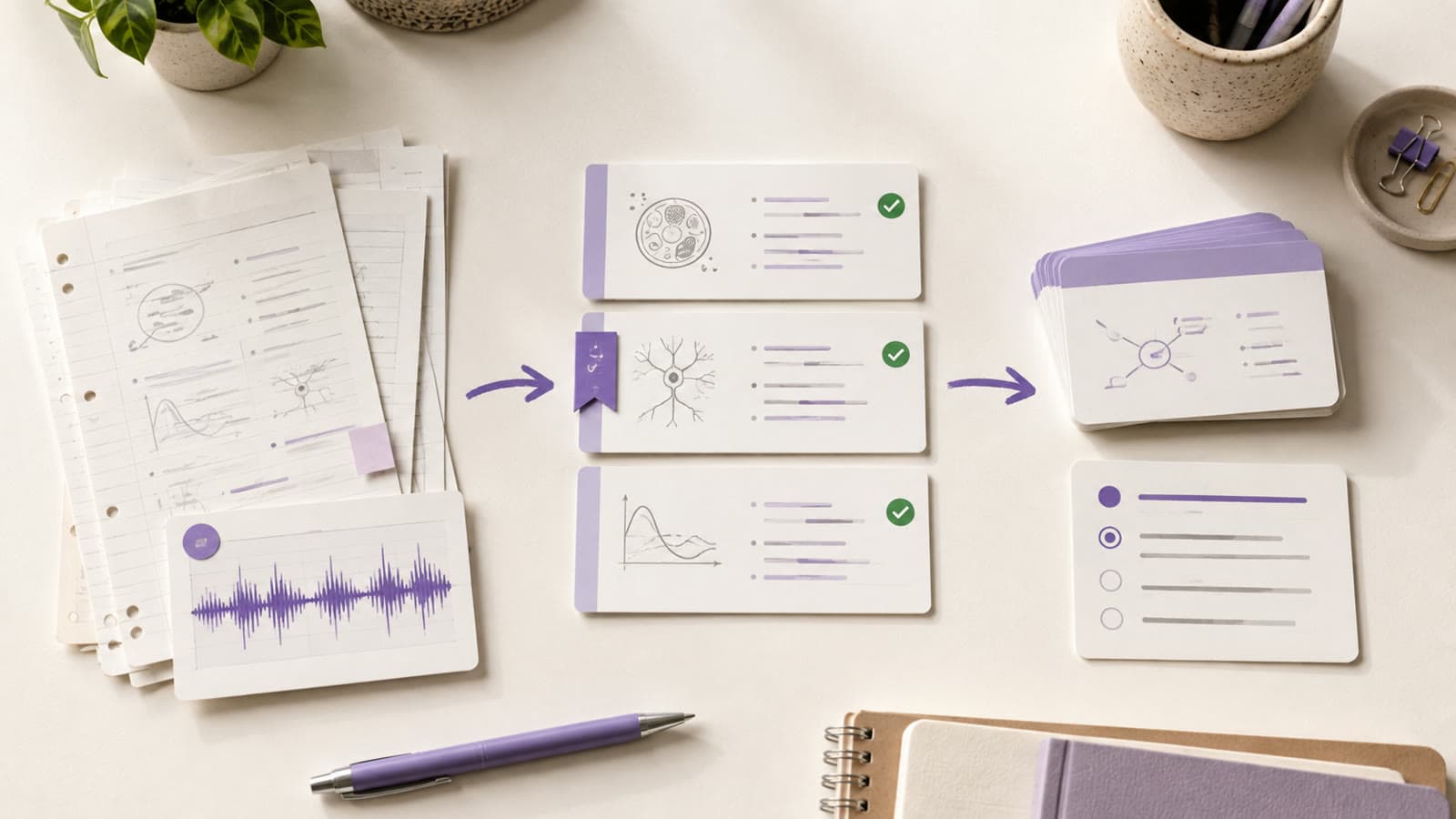
The lecture recovery loop
Move from an unsorted lecture backlog to priority notes, then into flashcards and closed-note questions that reveal the next gap.
Compress each missed lecture into one testable unit
Do not begin by writing a polished transcript. Skim the slides, recording, or assigned chapter for learning objectives, repeated ideas, worked examples, and connections to the next lecture. Build a short map containing the central question, three to five core ideas, one example, and anything you still cannot explain.
AI can accelerate this first pass by structuring a PDF or lecture recording, but it cannot know which off-slide comment your lecturer emphasized. Compare the result with the original material, add course-specific context, and verify names, formulas, dates, and policies before relying on the note.
- One sentence: what problem was this lecture trying to solve?
- Three to five ideas: what must you be able to explain without the source?
- One example or diagram: how is the idea applied?
- One gap: what needs a textbook, classmate, tutor, or instructor?
Switch from catching up to retrieval as early as possible
A complete-looking note can hide weak understanding. Close it and answer a small set of questions from memory. A classroom meta-analysis covering 222 studies and 48,478 learners found that quizzing produced a medium improvement in achievement overall. Retrieval gives you something rereading cannot: evidence about what you can actually produce unaided.
Use feedback immediately, but do not turn every mistake into another hour of note-making. Correct the misconception, write one short cue, and try a changed version of the question later. The backlog becomes manageable when wrong answers determine the next review instead of every page receiving equal attention.
A realistic 48-hour lecture catch-up plan
The plan below is deliberately small. If your backlog is larger, repeat the cycle rather than attempting an all-night reset. A 2025 meta-analysis of classroom research found a moderate advantage for distributed over massed practice, so spacing the repair work is not merely easier to tolerate; it also supports learning.
- First 20 minutes: inventory the backlog and contact the instructor about anything time-sensitive.
- Day 1, block 1: protect the current lecture, assignment, or lab preparation.
- Day 1, block 2: compress the highest-priority missed lecture and answer five closed-note questions.
- Day 2, block 1: review yesterday's misses before opening the source.
- Day 2, block 2: process the next prerequisite lecture, then schedule the remaining items across the week.
Use AI as a recovery assistant, not a replacement course
Keep the AI bounded to material you are allowed to upload. Ask it to identify structure, generate source-grounded questions, and explain a gap after you attempt it. Do not ask it to invent what happened in a missing lecture or assume a generated deadline is correct. UNESCO's education guidance emphasizes human judgement, privacy, and an age-appropriate, human-centred approach.
Brainote supports this recovery loop in one workspace: import a lecture PDF, recording, web source, or pasted text; inspect the structured note; generate flashcards and quizzes; then chat with that same note when a concept remains unclear. Start with one high-priority lecture, not the entire semester. The first useful result is a smaller backlog and a clear next action.
Sources and further reading
- 1.Guide to lectures (UNSW Sydney)
- 2.Making the most of your independent study time (University of Leeds Libraries)
- 3.Testing (quizzing) boosts classroom learning: A systematic and meta-analytic review (PubMed)
- 4.The Distributed Practice Effect on Classroom Learning: A Meta-Analytic Review of Applied Research (PubMed)
- 5.Guidance for generative AI in education and research (UNESCO)
FAQ
How many missed lectures should I catch up on per day?
Choose one or two bounded lectures while keeping current work protected. The right number depends on their difficulty, your deadlines, and whether later classes depend on them.
Should I watch every missed lecture at full speed?
Not automatically. Use the syllabus, slides, and assessment requirements to identify high-value sections, but watch complete explanations when the topic is foundational or the slides lack essential context.
Can AI catch me up on a lecture I did not attend?
AI can structure the available recording, slides, or readings and create practice questions. It cannot recover comments that were never recorded, and important details still need verification against course sources or the instructor.
What if I am too far behind for this plan?
Contact the instructor, academic adviser, or student support service quickly. Ask which work is still recoverable and what should be prioritized instead of silently guessing at requirements.
How to Catch Up on Lectures Without Falling Further Behind
A practical lecture catch-up plan for college students: triage the backlog, protect current classes, turn missed material into active recall, and use AI without trusting it blindly.