
Open book does not mean unprepared: build notes you can actually use
A practical guide to permitted resources, quick-reference notes and timed application practice, with an example you can adapt.
1. Check what open-book means for this particular exam
Start with the assessment instructions. An open-book exam permits specified resources; it does not automatically permit the internet, a phone, collaboration or AI. Cornell advises checking both the allowed materials and the format. Ask your instructor about anything unclear before building your revision system.
Write a short permission checklist: paper or digital notes, page limits, books, calculator, internet, AI tools, and any citation requirements. Record the working time separately from the submission window. A paper available for six hours may still allow only a 60-minute attempt. Rehearse within the actual attempt limit.
2. Separate understanding from finding a reference
A reference can remind you of a formula without telling you when to use it. UNSW describes open-book assessment as finding and applying knowledge. For each learning objective, write two questions: 'Can I explain or apply this?' and 'Where would I verify a detail?' These reveal different gaps.
Try a question before opening your notes. Then check the answer and explain why your chosen method fits. A missing definition needs review; choosing the wrong method needs a comparison or another worked problem. Merely adding more pages to your folder will not fix either diagnosis reliably.
3. Make an index that points to answers, not another summary
Use one compact index with four fields: topic, when it matters, exact source location, and a common mistake. The University of Melbourne recommends summaries with page references and a system for locating information. The index should lead to your checked notes; it should not try to replace the entire course.
Here is an illustrative row, with invented locations to replace with your own: 'Mean and median | comparing a typical value when an outlier is present | Lecture 4, slides 12–14; notebook page 8 | do not use the midpoint of the smallest and largest values as the median.' Another row might point to the assumptions of a method rather than its definition. Test each locator before trusting it.
- Keep one authoritative version of each note and use consistent topic names.
- For paper, check the tabs and page numbers. For permitted digital files, test filenames, bookmarks and search terms.
- Add units, assumptions or source references where the question type needs them.
- If only one sheet is allowed, prioritise recurring decisions and useful locators within that rule.
4. Practise applying a reference: a worked example
Suppose four journey times are 4, 5, 6 and 45 minutes. A practice prompt asks: 'Which measure better describes a typical journey, and what does the other measure tell us?' The mean is (4 + 5 + 6 + 45) / 4 = 15 minutes; the median is (5 + 6) / 2 = 5.5 minutes. Finding the definitions is only the first step.
A useful answer explains that the long journey pulls the mean upward, while the median describes the centre of this ordered sample with less influence from that extreme value. If the task concerns average time spent across all four journeys, the mean still answers a meaningful question. The point is to justify the choice in context, rather than declare the median universally better. Check arithmetic, units and interpretation separately.
Organise, rehearse, repair
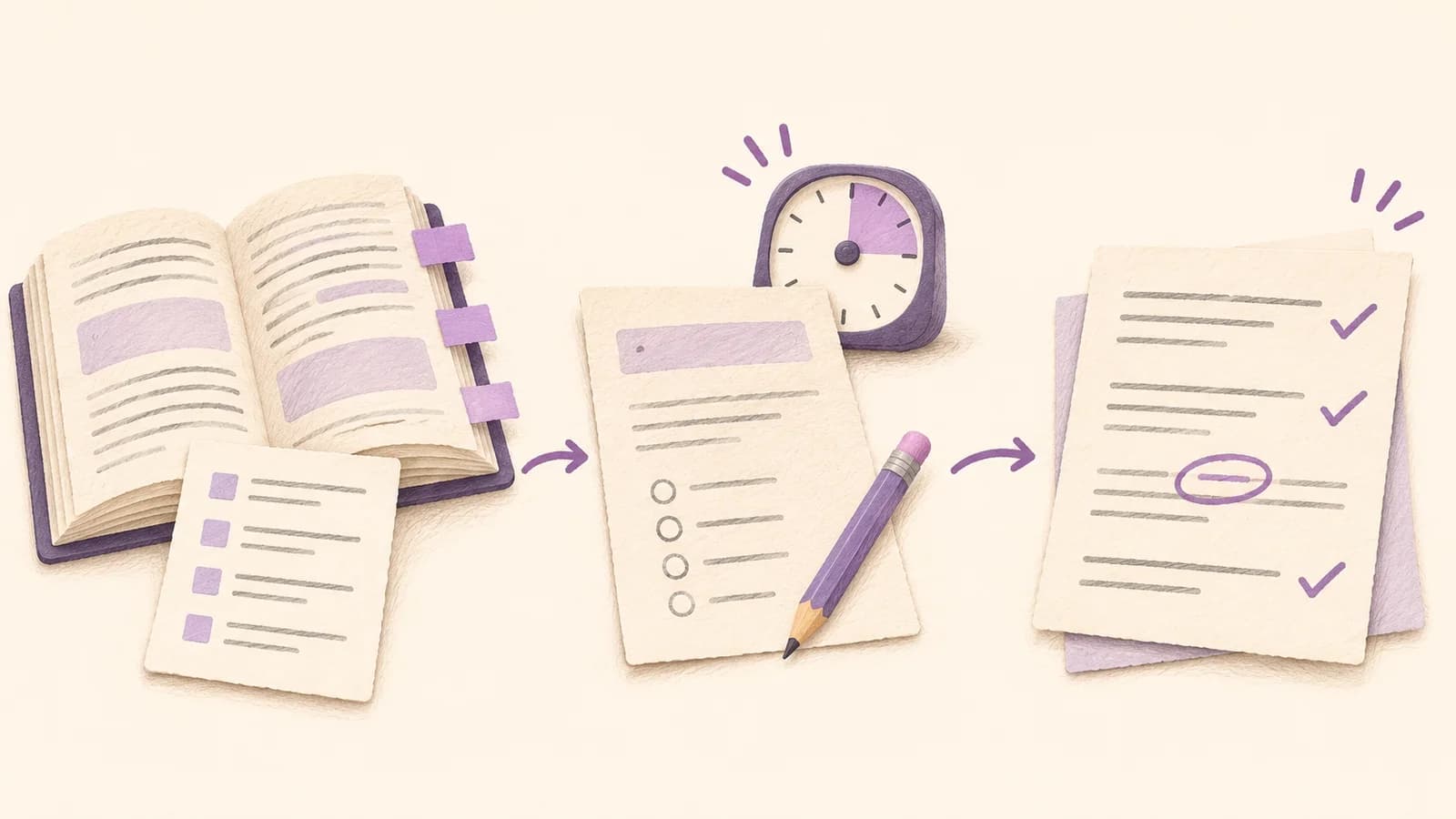
Use an index to find a reference, attempt a timed question, then repair the specific mistake. Adjust the routine to your assessment.
5. Run a 20-minute rehearsal with your allowed materials
Melbourne recommends practice under exam-like conditions. As an original starting routine, spend two minutes planning one question, twelve answering, three checking references and three reviewing errors. Adapt those timings to your course; this is a practice template, not a validated optimum. Prefer instructor-provided questions when available.
Afterwards, label each difficulty: understanding, locating, applying, or finishing. If searching consumed the time, improve the index. If the source was found quickly but the explanation was weak, practise the concept. Repeat later with a changed problem so remembering yesterday's answer does not disguise a gap.
6. Use the mobile app during preparation, within your course rules
Before exam day, Brainote's mobile notes, flashcards and quizzes can support short review sessions. Use a course note to draft a question, attempt it and compare the generated explanation with the original material. AI output can contain mistakes or omit an important condition; correct those before using it as a reference.
Build the final index and permitted reference pack in a format you have checked yourself. This workflow does not promise automatic exam indexing, a timed-exam mode or a particular export format. Open-book permission alone does not authorize using Brainote or any AI during the assessment. Follow your instructor's explicit rules for preparation and for the exam itself.
7. Finish with a resource check, then answer the question asked
The day before, locate three topics in your reference pack, verify the permitted files or printed pages, and check the assessment platform's submission instructions. Prepare the allowed resources rather than assuming every digital tool will be available. Keep a short list of unresolved course questions to ask while there is still time.
During the exam, read the task, plan the response and consult references for a specific purpose. Cornell cautions against repeated checking and over-answering. Stop when you have met the question's requirements, supported the reasoning and checked the details that matter. Afterwards, record whether knowledge or navigation caused the biggest delay; that is the next preparation task.
Sources and further reading
- 1.Open-book exams: preparation and reference materials (Cornell University Learning Strategies Center)
- 2.Open-book and take-home exam guidance (UNSW Sydney)
- 3.Open-book exams: organisation and practice (University of Melbourne)
FAQ
Do I need to memorise anything for an open-book exam?
You need enough understanding to recognise concepts, choose methods and build an answer. Use permitted references for details; do not plan to learn the course during the assessment.
How many pages of notes should I bring?
Follow the stated limit. Within it, choose a small, tested reference pack that supports the assessed topics, rather than maximising the number of pages.
Can I use AI or my phone in an open-book exam?
Only if the assessment instructions explicitly allow that use. Permission to consult notes is not permission to use AI, a mobile app or the internet.
What if I have only one evening to prepare?
Check the rules and scope, select existing course notes, build a short index and attempt one representative question. Repair the biggest gap you find rather than rewriting all your notes.
How to Study for Open-Book Exams: Notes, Practice and Timing
Prepare for an open-book exam with a usable note index, a worked application example and a 20-minute practice routine. Learn what to check before exam day.