
Questions are where note-taking starts to become learning
Use note-based quizzes to expose weak spots, correct them with feedback, and make review measurable.
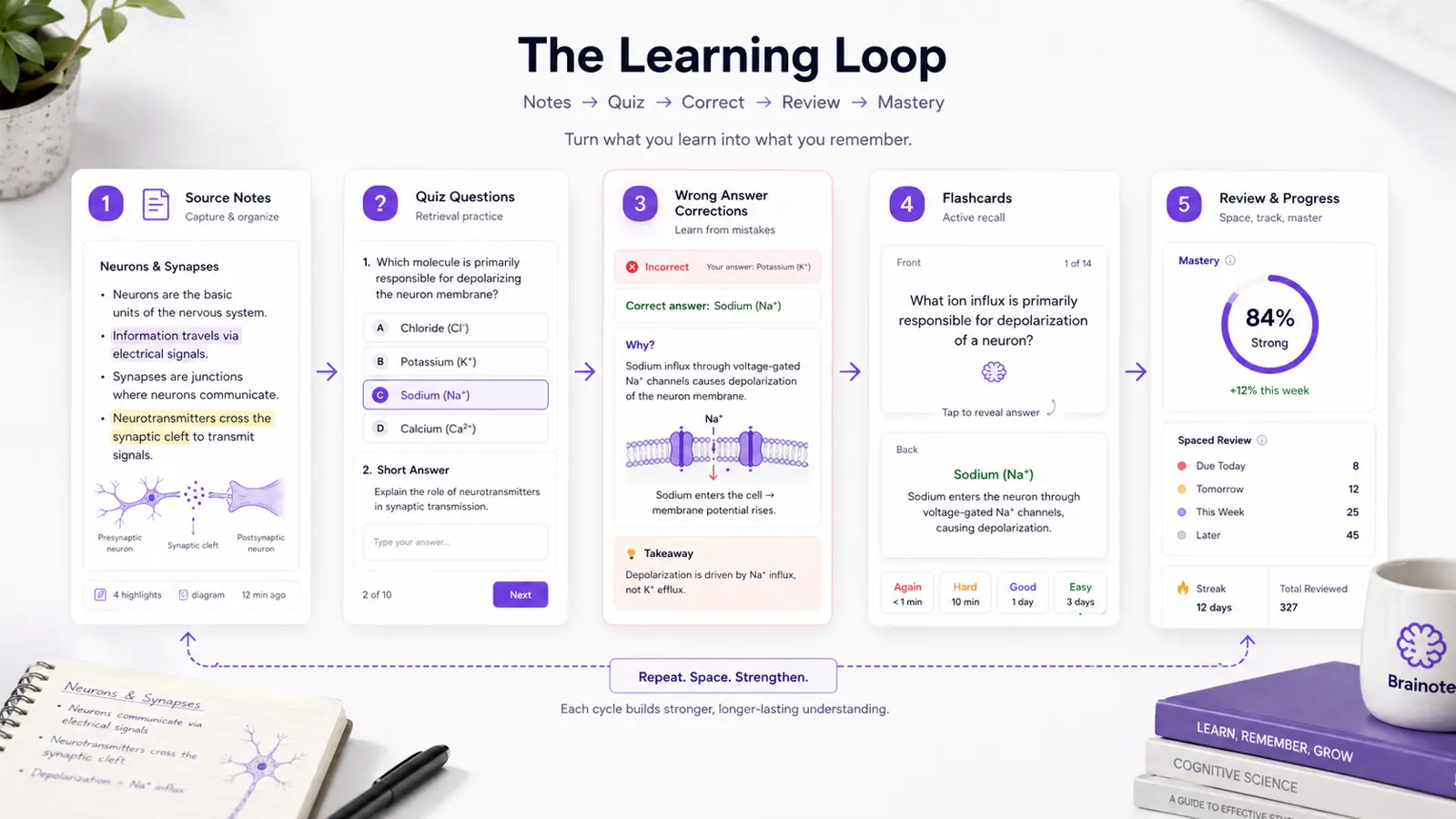
Why quiz generation is the strongest of the three workflows
Out of note capture, summarization, and quiz generation, quiz generation has the clearest research tailwind. Practice testing repeatedly outperforms passive restudy for long-term retention, especially when learners get feedback and revisit the material over time.
That does not mean every quiz is good. Low-quality quizzes can reduce rich material to trivial fact recall. But even with that warning, note-based questions are usually a stronger endpoint than a polished summary because they force you to retrieve rather than simply reread.
This is why a quiz generator from notes has real value when it is tied to a study workflow. It converts static information into something you can fail, correct, repeat, and eventually remember.
The quality of the questions matters as much as the quantity
Good note-based quizzes do not ask only for isolated definitions. They ask for contrasts, steps, causes, consequences, and examples. If your subject is conceptual, short-answer prompts are often more diagnostic than multiple-choice. If your subject is detail-heavy, multiple-choice can still work, especially when you review why the distractors were wrong.
A useful way to audit a generated quiz is to sort questions by cognitive job. Are you identifying terms, explaining mechanisms, comparing ideas, or applying a principle to a new case? If every question sits in the first category, the quiz probably needs editing.
This is another place where AI should be treated as a draft partner. Let it generate the first version, then tighten the wording so the questions match what your course actually emphasizes.
Feedback is not optional
Questions alone are not enough. The biggest gain comes when wrong answers produce immediate correction and a chance to try again later. That is one reason quiz workflows can outperform vague review sessions: they generate evidence about what you do and do not know.
Feedback also prevents a common trap in note-based studying: overconfidence. When students reread notes, recognition can feel like mastery. When they answer a question and miss it, the weakness is visible. That discomfort is useful because it tells you where the next review block should go.
If your generator can attach explanations or source-linked answers, even better. That shortens the path from mistake to repair.
A note-to-quiz workflow that stays manageable
The best quiz systems are small and repeatable. You do not need to turn an entire semester into one giant question bank in a single weekend. Start with one lecture set, one chapter, or one exam unit.
Generate a short quiz, answer it, inspect the misses, and convert only the stubborn items into flashcards or repeated review prompts. That creates a tighter loop than endlessly producing more and more questions.
- Generate a short quiz from one bounded set of notes.
- Mix recall types: definitions, comparisons, steps, and applications.
- Review incorrect answers immediately with a short explanation.
- Reuse missed items in the next study block instead of writing a new summary.
FAQ
Should I use multiple-choice or short-answer questions?
Use both when possible. Short-answer is usually better for pure retrieval, while multiple-choice can help with coverage and speed if the feedback explains the distractors.
How many quiz questions should come from one lecture or chapter?
Enough to cover the high-yield ideas without flooding yourself. For many students, eight to fifteen solid questions are more useful than forty shallow ones.
Can quizzes replace flashcards?
Not entirely. Quizzes are excellent for diagnosis and varied practice. Flashcards are better for repeated review of the specific items you keep missing.
Quiz Generator From Notes: Why Turning Notes Into Questions Works Better Than Rereading
A practical guide to generating quizzes from notes using retrieval-practice principles instead of passive review habits.